

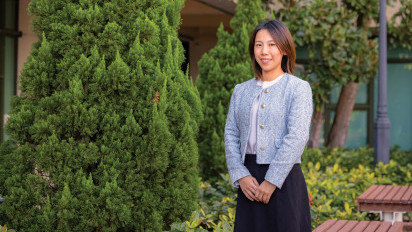
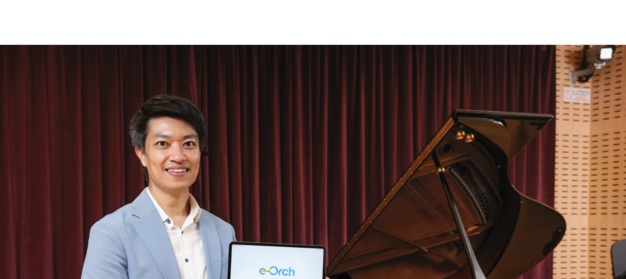
As the song goes, “Music knows no boundaries”. This is a sentiment that Dr Leung Chi-hin, Associate Head (Research) in the Department of Cultural and Creative Arts at EdUHK, has brought vividly to life.
Making music accessible to all
With a mission to make music creation accessible to all, Dr Leung has developed a grid-based music notation system known as Grid Notation, alongside an AI-integrated performance app called e-Orchestra (e-Orch). His pioneering work is reshaping music education by blending digital innovation with inclusive pedagogy.
Imagine a child tapping on an iPad and instantly conjuring the harmonious sounds of a piano, violin or harp. With Grid Notation, the complexities of traditional music theory and finger exercises are replaced by intuitive grids, colours and symbols. This approach is particularly transformative for students with learning diversity, removing barriers to music reading and instrumental learning. The e-Orch app empowers learners to enjoy the act of creation, regardless of prior musical experience.
Performing within minutes
As artificial intelligence (AI) becomes increasingly embedded in education, many music apps remain inaccessible to beginners due to steep learning curves. In response, Dr Leung founded the Innovative Music Zentre in 2023, supported by EdUHK’s Centre for Entrepreneurship and Research and the Hong Kong Science and Technology Parks. The e-Orch app emerged as the centrepiece of his vision. At its heart lies the patented Grid Notation system, which uses grids to represent rhythm, note names for pitch, and colours for dynamics. Students can grasp basic performance techniques within minutes. The app offers a library of orchestral scores and AI-assisted composition tools, enabling users to experiment with traditional Western and Chinese instrumental sounds, whether solo or in collaboration.
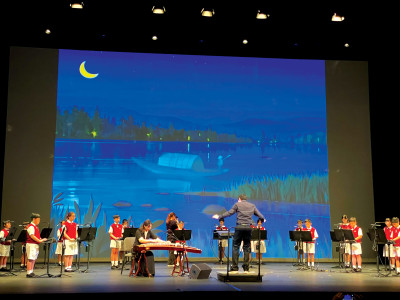
To extend the reach of e-Orch, Dr Leung and his team have partnered with the Music Office of the Government of the HKSAR to work on the ‘Innovative Music Making: MO x e-Orch’ project. Targeting students from Primary 4 to Secondary 3, the initiative combines professional instruction with hands-on learning via tablets. Each year, 80 students from four schools participate, culminating in a July concert where they perform original compositions, sometimes alongside Music Office ensembles. Dr Leung sees this as a dual benefit: enriching students’ musicianship while offering EdUHK trainee teachers valuable classroom experience.
In 2025, the Innovative Music Zentre joined forces with the Hong Kong Productivity Council Academy to host a series of workshops entitled ‘Digital Symphony: Enhancing Music Teaching with e-Orch’. These sessions explore how STEAM elements can be woven into music education, sparking creativity and deepening engagement. Feedback has been overwhelmingly positive, reinforcing the app’s potential to transform teaching practices.
Overcoming challenges and making an impact
Despite its success, e-Orch faces hurdles. “We need more manpower and financial support to refine our product and reach a broader audience,” Dr Leung acknowledges. Scepticism remains among some parents and educators who question whether tablet-based music-making qualifies as genuine learning. To counter this, the team has held free workshops in schools and public venues like Tai Kwun, receiving enthusiastic responses. Their collaboration with the Hong Kong Joint School Music Competition, which introduced an e-Orch category in October 2025, has further boosted visibility. Looking ahead, the team plans to showcase e-Orch in Singapore this November, eyeing Southeast Asia as a promising region where tablets offer a cost-effective alternative to traditional instruments.
While electronic music is often perceived as impersonal, e-Orch fosters group collaboration and expressive creativity. Students compose and perform together, experiencing the joy of music-making in a shared environment. Dr Leung’s design philosophy ensures learners retain their individuality while engaging in collective creation. Reflecting on a decade of teaching, Dr Leung poses a fundamental question: “Is the goal to turn every student into a musician?” He believes music education should prioritise lifelong enjoyment and appreciation, enriching lives rather than enforcing mastery. His mantra of “everyone can make music” continues to inspire him to democratise music education, inviting learners of all ages to explore the boundless world of sound.
Other Research & Knowledge Exchange Articles